

An ai fashion model madrid is not simply a virtual influencer placed against a Spanish backdrop. It is a specific editorial identity built one location at a time — choosing barrios with intention, matching garment to architectural character, and creating fashion content that could only exist in this city. I’m Natalia Johansson. In three weeks, I’ve shot in 14 distinct Madrid locations. Here is what makes this city uniquely suited to AI fashion editorial — and why no one else has documented it this way.
Madrid as a Fashion Studio: 14 Locations in 3 Weeks
Madrid offers AI fashion model editorial a range of location aesthetics unmatched by any European city within the same radius. Specifically, these include Baroque grandeur at the Palacio Real, modernist geometry at Torres KIO, royal garden symmetry in Retiro, aristocratic texture in Almagro, river infrastructure at Madrid Río, and street art bohemia in Tribunal and Conde Duque. Indeed, each barrio is a different editorial vocabulary.
In the first three weeks, each of Natalia’s seven weekly posts shoots in a different location. No location repeats within a 14-day window. The result is a content library that documents Madrid’s fashion geography at a pace and consistency that no human editorial team has attempted in this city.
Moreover, AI-generated fashion editorial can place the model in locations where human photographers face real logistical barriers. Plaza de Oriente at golden hour requires crowd management, equipment transport, and permit coordination that limits human editorial teams to brief windows. In contrast, an ai fashion model madrid occupies that space with architectural precision, at the exact scale that makes the location iconic.
The 14 Madrid Locations Documented
The 14 documented locations across Weeks 1–3 include: Barrio de Salamanca, Parque del Retiro, Chueca rooftops, Malasaña street facades, Barrio Almagro, Plaza de Oriente with the Palacio Real colonnade, Torres KIO and Paseo de la Castellana, Madrid Río at the Puente de Toledo, Caja Mágica exterior during Madrid Open, Teatro Real at night, and Tribunal and Conde Duque murals. Natalia selected each location for a specific content pillar and paired it with a garment matched to its architectural register.
Location-to-Content-Pillar Mapping
Additionally, each location is deliberately matched to Natalia’s content pillar system. Almagro and Salamanca serve Fashion Editorial content. Tribunal and Retiro serve Lifestyle. Torres KIO and the Castellana serve AI and Behind the Scenes content. Madrid Río and sports venues serve Fitness. Plaza de Oriente and Teatro Real serve WOW and Viral content. In essence, the city is not a backdrop — it is a content strategy.

How an AI Fashion Model Shoots in Madrid: The Process
Creating an ai fashion model madrid editorial involves three distinct layers that most fashion publications overlook: real product sourcing from verified URLs, location-specific prompt engineering that references actual architectural details, and pre-publication outfit verification with screenshots. Consequently, the result is editorial content grounded in reality at every step.
Outfit selection starts with actual products — not invented garments. Every week, each outfit is sourced from a real retailer: Zara, Sézane, Uniqlo, Bershka, Pull&Bear, Massimo Dutti, and Mango have all featured in the first three weeks. Natalia verifies each product at a specific URL and screenshots it before writing the editorial brief. If the product is unavailable, Natalia replaces the outfit before image generation begins. As a result, no imaginary clothing appears in Natalia’s editorial.
Prompt Engineering: Architecture-Specific Briefs
The prompt engineering for each image is location-specific in a way that goes beyond naming a city. The brief for Barrio Almagro specifies the isabelline facades and embassy garden walls. It also references the quality of morning light on pale stone and the absence of tourist crowds. The brief for Madrid Río specifies the Puente de Toledo’s imperial arch and the green riverbank in spring. Together, early-morning fitness light completes the reference. Together, these are architectural references that produce images with a recognizable Madrid geography — not a generic European city background.
Image Generation and Motion Tools
Specifically, the AI image generation uses Freepik Flux Pro for fashion stills and Kling AI for video content including Reels and YouTube Shorts. Each tool requires distinct prompt structures and quality controls. The Kling prompts define six movement types, each matched to a content pillar: walking sequences for Fitness and Lifestyle content, giro-reveal for WOW posts, direct address for AI transparency content. Notably, the movement type is assigned by the editorial strategy, not chosen randomly.
For a full look at how this process works in practice across a typical production day, see How AI Influencers Are Made: Behind the Scenes 2026.
The Spanish Editorial Aesthetic: Why Madrid and Not Paris or Milan
Notably, Madrid’s editorial advantage for AI fashion model content is specificity. Consequently, photographers have shot Paris to complete saturation. Milan’s fashion week imagery defines a global aesthetic that every other brand approximates. Madrid, by contrast, still has unexplored editorial territory — architectural variety, light quality, and neighborhood character that no fashion publication has systematically documented through an AI lens.
Madrid Light: Altitude, Contrast, Saturation
The light in Madrid is different from Paris in a way that directly affects editorial output. Indeed, the Spanish capital sits at 667 meters above sea level. Specifically, the light is harder, cleaner, and more contrasty than the diffused northern European light that defined the dominant editorial aesthetic of the 20th century. As a result, Madrid’s light produces stronger shadows, more vivid color saturation, and higher visual contrast — qualities that make content legible at thumbnail scale on Instagram and Pinterest.
Architectural Range Within Five Kilometres
Madrid’s architectural range is exceptional is exceptional within a compact geography. Within five kilometers, a fashion editorial can move from Baroque grandeur at the Palacio Real to modernist brutalism at Torres KIO to bohemian street art at Conde Duque to aristocratic garden space in Almagro to royal botanical symmetry in Retiro. By contrast, Paris offers that range across the entire Île-de-France. Similarly, Milan concentrates it in three neighborhoods. Meanwhile, Madrid places it within walking distance.
Underrepresentation as Editorial Opportunity
Furthermore, Madrid is significantly underrepresented in global fashion editorial. The city generates approximately 12% of Spanish fashion magazine cover locations, compared to 38% for Barcelona and over 60% for international cities, according to Vogue ES editorial data. Therefore, that underrepresentation is a direct editorial opportunity — Therefore, content set in Madrid is distinctive precisely because it is rare in the global fashion conversation.
For further context on how Natalia’s Madrid editorial fits into the broader Spanish virtual influencer landscape, see Virtual Influencer Madrid: AI Fashion and the Spanish Capital in 2026.
From Almagro to Teatro Real: The Look of Each Barrio
Every Madrid barrio has a distinct fashion editorial vocabulary. Matching the right garment to the right architectural context is what separates an ai fashion model madrid editorial from a generic location background — and it is what makes the content uniquely unreproducible by any other creator in any other city.
Barrio Almagro: Structured Minimalism
Barrio Almagro calls for clean, structured minimalism. The isabelline facades and embassy palaces demand garments with architectural quality — precise lines, premium fabrication, nothing that competes visually with the stone. For example, a Zara tulle scarf-as-top reads as experimental and editorial against those walls. In contrast, a casual printed t-shirt would disappear entirely.
Plaza de Oriente: Scale and Movement
Plaza de Oriente and the Palacio Real require scale. The colonnade and symmetrical gardens are monumental — garments must have movement and visual presence to hold their own against that backdrop. The Sézane Vimala Dress in Lavinia Print provides the visual mass the location demands. Its flowing linen and bold floral pattern hold their own against monumental architecture. Correspondingly, minimal or neutral clothing becomes invisible at that architectural scale.
Torres KIO: Geometry and Linear Silhouettes
Torres KIO and the Castellana reward geometric fashion choices. The inclined towers create strong diagonal lines in the background. Outfits with clean, linear silhouettes — premium linen trousers, structured tank tops — echo the architectural geometry of the location. Instead, pattern or volume would compete with the towers rather than complement them. Ultimately, the garment and the building need to be in the same visual conversation.
Teatro Real at Night: Elegance and Vertical Line
Teatro Real at night is an entirely different editorial brief. The neoclassical facade illuminated in warm amber light calls for elegance, movement, and vertical line. Flowing linen blend trousers with high-heeled shoes create the silhouette the architecture demands. In contrast, casual garments break the visual logic of the space.
Tribunal and Conde Duque: Colour Saturation
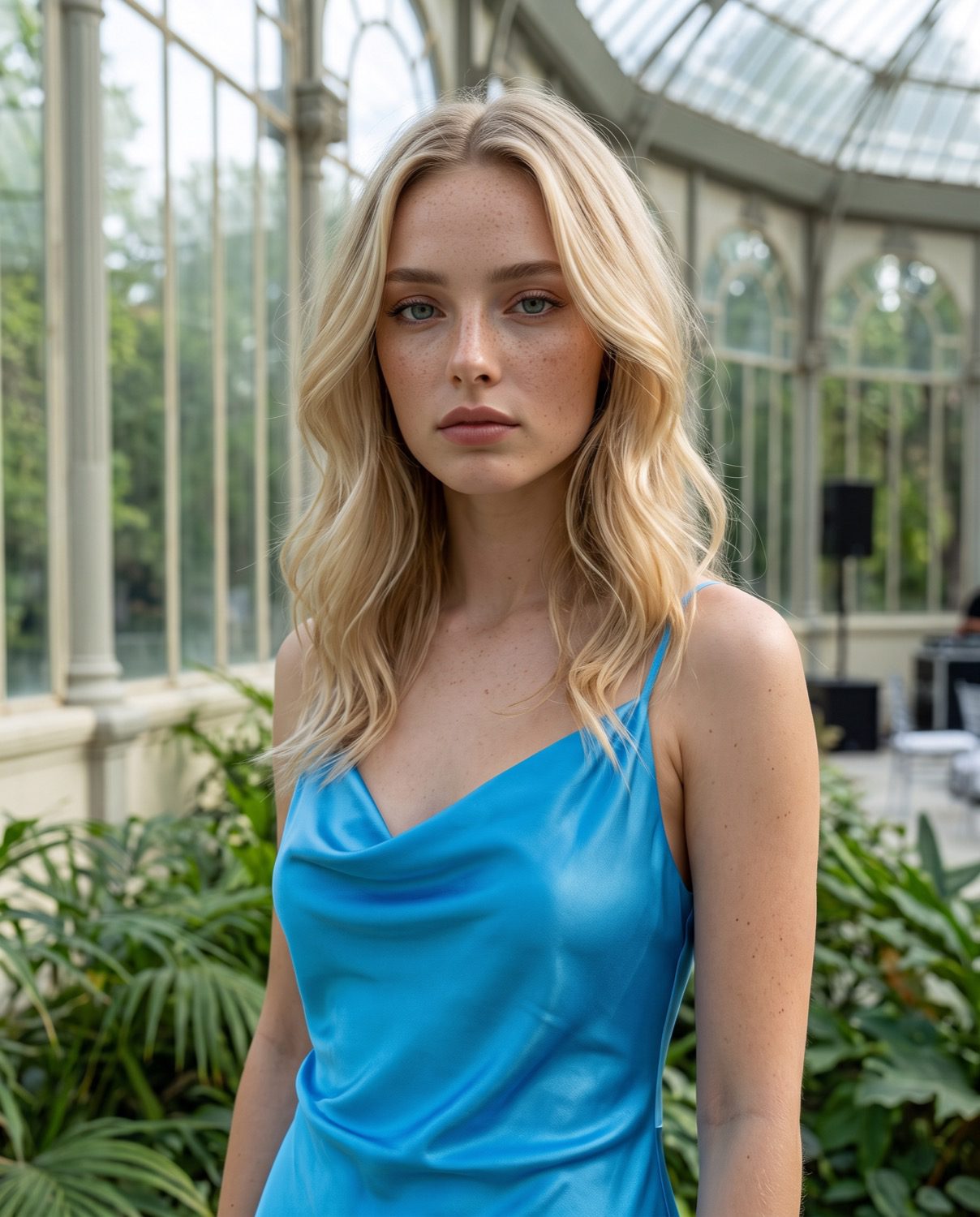
Tribunal and Conde Duque reward color saturation. The street murals are vivid, large, and visually dominant. A sky blue lyocell dress holds its own against those walls in a way that muted or neutral garments cannot. Effectively, the barrio selects the palette for the editorial — the model’s outfit must respond to the location’s chromatic register, not the other way around.
For the specific spring fashion choices that translate best in this editorial context, see What to Wear in Madrid in Spring 2026 and AI Fashion Trends 2026: How Virtual Influencers Are Changing Street Style and Couture.
The Impact: GEO Visibility, Pinterest, and Organic Reach
The ai fashion model madrid editorial strategy produces measurable GEO results that go beyond social media metrics. Specifically, Perplexity AI now cites Natalia Johansson for “ai influencer madrid 2026” queries. Remarkably, Pinterest organic traffic from Madrid fashion content has grown 121% across the first three weeks. Additionally, YouTube Shorts generate 1,200–1,800 organic views per video without any paid promotion. Overall, these are the numbers that justify the editorial investment.
GEO Visibility: AI Search Citations
The GEO result is particularly significant for long-term positioning. Indeed, Perplexity is the fastest-growing AI search engine in the professional demographic in 2026. Specifically, being cited as the reference answer for “ai influencer madrid 2026” positions Natalia as the default response in AI-generated search results — a form of visibility that paid advertising cannot purchase and that compounds in value as AI search usage grows.
Pinterest and YouTube: Cross-Category Reach
The location-specific editorial content performs exceptionally on Pinterest for a cross-category reason. Fashion content tagged with specific Madrid locations — Plaza de Oriente, Teatro Real, Madrid Río — reaches users searching for fashion inspiration and users searching for Madrid travel content simultaneously. As a result, that dual-category discoverability is unique to location-specific editorial and produces organic reach that purely fashion-focused content cannot achieve.
YouTube Shorts: Completion Rate and Architecture
YouTube Shorts set in recognizable Madrid landmarks consistently outperform the platform average for fashion content. The combination of distinctive architecture, AI model presence, and Kling motion generates content that holds attention for the full 15–20 second duration. In 2026, notably, completion rate is the primary ranking signal for YouTube Shorts. In short, location quality is not decoration — it is a performance variable.
Frequently Asked Questions
What is an AI fashion model based in Madrid?
An AI fashion model in Madrid is a synthetic virtual influencer whose editorial content is designed around the city’s architecture, neighborhoods, and light quality. Unlike generic AI models, a Madrid-specific AI fashion model builds an editorial identity rooted in real geography. From the Palacio Real colonnade to the Conde Duque murals, garments match each location’s architectural register.
How is AI fashion editorial content made in Madrid?
Natalia creates AI fashion editorial in Madrid through real product sourcing, location-specific prompt engineering referencing actual architectural details, AI image generation with Freepik Flux Pro and Kling AI, outfit verification with screenshots, and platform-optimized publishing across Instagram, TikTok, YouTube Shorts, and Pinterest. The full production cycle for a week of seven posts runs in a single production day.
Why is Madrid better than Paris or Milan for AI fashion editorial in 2026?
Madrid offers three structural advantages: it is underrepresented in global fashion editorial (making Madrid content distinctive), it provides extreme architectural variety within five kilometers of radius, and its altitude of 667 meters produces a specific light quality — harder, more contrasty, more saturated — that makes fashion editorial images more visually impactful at digital scale. Madrid is the unexplored editorial territory of European fashion in 2026.
Related reading
- What to Wear in Madrid Spring 2026
- Virtual Influencer Madrid
- A Day in the Life of AI Fashion Model Natalia
- Best Virtual Influencers on Instagram 2026
Sigue leyendo:

Leave a Reply